
Cooking bacon in pan with water added

I heard that adding water to a pan before cooking bacon is recommended. can you elaborate on this in detail?
ChatGPT said:
Yep — starting bacon with a little water is a legit technique, and it’s mostly about control: you get more even rendering, less curling, and often crispier bacon with less scorching.
What adding water actually does
Bacon has a mix of fat + water + protein/sugars. The crisping you want happens after the fat renders out and the surface can brown. When you add water at the start:
- Temperature is capped around 212°F / 100°C (until the water boils off).
That prevents the pan from getting hot enough to scorch the bacon before the fat has time to melt out. - It gives the fat time to render gently.
Rendering is the key step: more fat melted out of the bacon = better texture and less rubbery chew. - It reduces curling and helps even cooking.
The bacon heats more uniformly, so the edges don’t seize up as fast and curl while the middle lags. - Less sputter (especially early on).
Early sizzling is calmer because the pan is cooler and the water buffers the heat. (Once water’s gone, it’ll sizzle normally.)
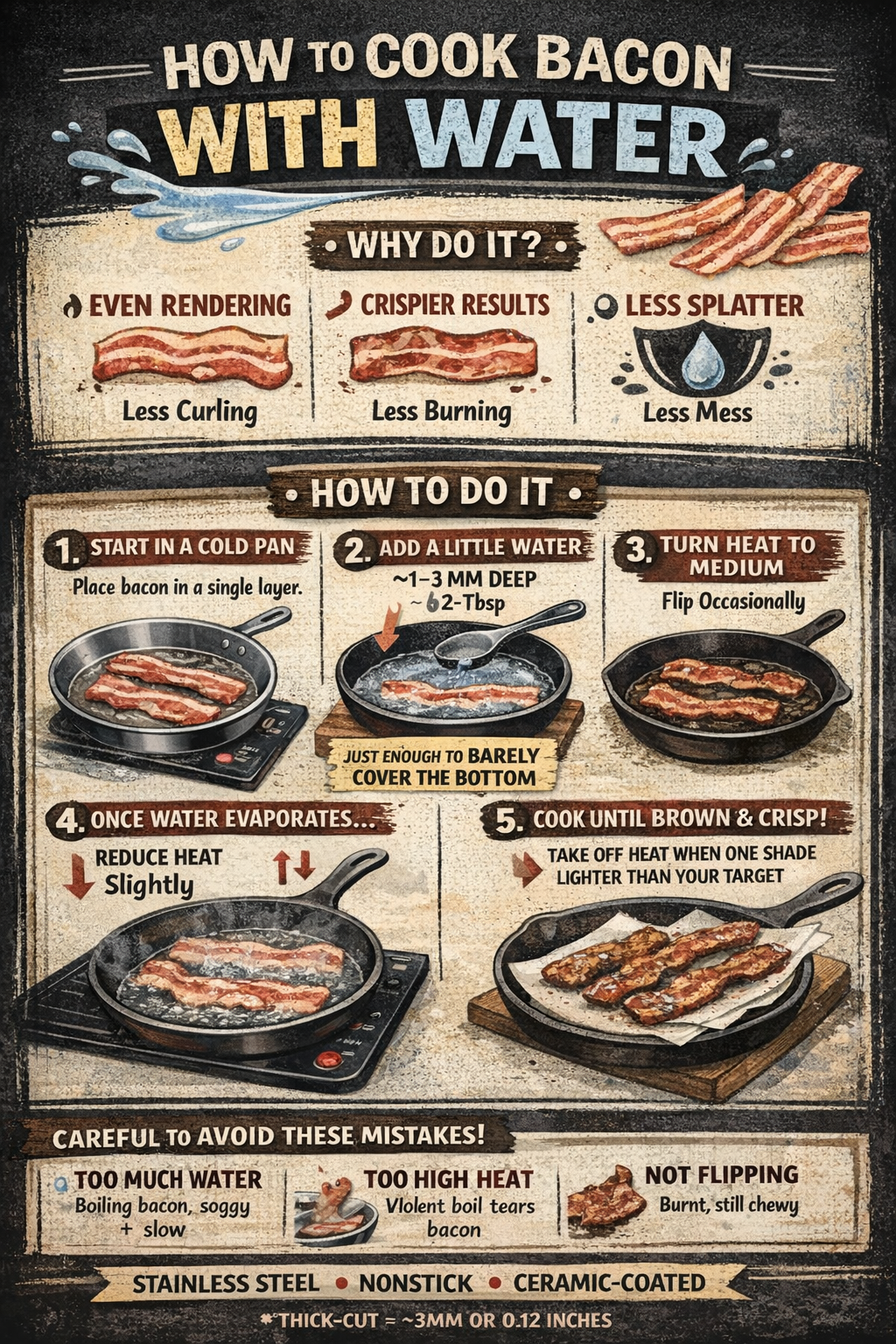
The basic method (works in stainless, cast iron, nonstick)
- Put bacon in a cold pan in a single layer (overlap is okay but slower).
- Add just enough water to barely cover the bottom or come up ~1–3 mm.
(For a 10–12" skillet: usually 2–6 tablespoons.) - Turn heat to medium (or medium-low if your stove runs hot).
- Let it simmer. Flip once or twice as it starts to render and the water level drops.
- When the water is gone, you’ll hear the sound change from a gentle simmer to a sharper fry.
Now the bacon is essentially frying in its own rendered fat — at this point you can:- keep at medium for steady browning, or
- drop slightly to medium-low if you want very even crisping.
- Pull bacon when it’s a shade lighter than your target — it crisps a bit more as it cools.
Why it can make bacon crispier
This sounds counterintuitive, but it’s because the “water phase” gives you a head start on rendering before browning starts. If you start in a hot dry pan, the outside can brown fast while fat inside hasn’t rendered yet — you end up with bacon that’s dark in spots but still chewy.
When it’s most useful
- Thick-cut bacon (big win)
- Bacon that curls hard
- Cast iron (prevents hot-spot scorching early)
- Batch cooking (more consistent results)
When you might skip it
- Super thin bacon: it renders quickly anyway, so water doesn’t add much.
- You want ultra-fast bacon: water adds a few minutes.
- Sugary glazes (maple/candied bacon): water can still work, but you need to be careful once it dries out because sugar burns easily.
Common mistakes
- Too much water: you’re effectively boiling the bacon and it takes forever. Use a thin layer.
- Heat too high: the water boils violently, bacon can tear, and once water’s gone it can burn quickly.
- Not flipping: you still want to turn it occasionally for even rendering and color.
Small upgrades (optional but useful)
- Use a lid or splatter screen during the water stage to reduce mess; remove it once water is mostly gone if you want better browning.
- Start with medium-low if you want very flat bacon (especially thick-cut).
- Pour off some rendered fat mid-cook if you’re doing a lot; too deep a fat pool can “deep-fry” the bacon and make it blister rather than evenly crisp.
If you tell me whether you’re using thin vs thick-cut, and what pan (cast iron / stainless / nonstick), I’ll give you a dialed-in heat and timing setup for that exact combo.
You said:
Thick bacon. the pan is large with a ceramic coating
ChatGPT said:
Perfect combo for the water method — thick-cut is exactly where it shines, and ceramic-coated pans do best with moderate heat + patience.
Thick-cut bacon in a ceramic-coated pan (best workflow)
1) Start cold + add a thin layer of water
- Lay bacon strips in a cold pan (single layer if possible).
- Add water so it just barely covers the bottom — think 1–3 mm deep.
- For a big skillet, that’s usually 3–6 Tbsp.
- You’re not trying to submerge the bacon, just give it a “heat buffer.”
2) Bring to a gentle simmer
- Heat: medium (or medium-low if your stove runs hot).
- Goal: gentle bubbling, not a rolling boil.
- Rolling boil = water evaporates too fast and can slap bacon around.
3) Render phase (the magic)
As it simmers:
- The bacon will turn from raw pink to lighter/opaque.
- Fat will start melting out and collecting.
- Flip every 2–3 minutes so it renders evenly and stays flatter.
This phase usually takes 5–8 minutes depending on thickness and stove power.
4) Transition: when water is mostly gone
You’ll notice:
- The sound changes from “soft simmer” to “sharper sizzle.”
- The fat in the pan is now doing the cooking.
At this moment:
- Reduce heat to medium-low (recommended for ceramic).
- Ceramic coatings dislike sustained high heat and it’s easier to overshoot.
5) Crisp + brown slowly
Keep flipping every 1–2 minutes.
- Total crisping time after water evaporates: 4–8 minutes.
Pull the bacon when it’s one shade less done than you want. It tightens and crisps slightly while resting.
6) Drain + rest
- Put on paper towels or a rack.
- Rest 2–3 minutes.
Heat guidance (ceramic-specific)
Ceramic-coated pans are great but:
- They can create hot spots if you crank heat.
- High heat can shorten the coating’s life and can make bacon scorch before it crisps.
So the winning pattern is:
- Medium to start → then medium-low once water is gone.
How much water is “right”?
A good rule:
- Enough that you can see a continuous film across the pan.
If you pour it and it beads up into patches, add a splash more.
Too much water symptoms:
- Bacon looks like it’s boiling and stays pale for a long time.
Fix: pour off a little water or raise heat slightly (but keep it controlled).
Troubleshooting
Bacon still curls a lot
- Start with medium-low, not medium, and flip more often early.
Edges brown too fast / center still floppy
- Heat is too high after the water evaporates. Drop to medium-low and keep flipping.
It’s taking forever
- You added too much water or heat is too low. Next time use less water; for now, bump heat slightly until you get a gentle simmer.
Sticking
- Usually from heat being too high once it’s dry. In ceramic, keep it moderate and let the fat build before trying to move pieces aggressively.
One extra tip for thick bacon
If your strips are really thick (like “steakhouse thick”):
- Cut them in half so they fit flat, or
- Start with a lid slightly ajar during the water phase to speed rendering without splatter.
If you tell me whether you like your thick bacon chewy-crisp or shatter-crisp, I’ll tell you exactly when to stop (color cues + approximate total time).
You said:
is there anything someone should know about if they try this water bacon cooking method with a cast iron pan?
ChatGPT said:
Yeah — it works great in cast iron, but there are a few “don’t accidentally mess up your pan” details worth knowing.
What’s different about cast iron with the water method
1) Rust risk is real (but easy to avoid)
Water + bare iron = rust if you leave moisture sitting around.
- Don’t let the pan sit wet after cooking.
- When you’re done, pour off water/grease, wipe, then heat the pan for 1–2 minutes to drive off moisture.
- Finish with a thin wipe of oil (especially if your seasoning is thin).
2) Cold water into a screaming-hot pan can crack it
Cast iron doesn’t love thermal shock.
- The water-bacon method should start from a cold pan anyway, so you’re safe.
- Just don’t preheat the pan and then dump in water.
3) Don’t soak it “to loosen bacon”
People sometimes think, “water loosens stuck bits, I’ll soak it.” Bad idea for cast iron.
- If something sticks, use hot water + gentle scraping while the pan is warm, then dry immediately.
4) Seasoning usually holds up fine — but acids + long simmer can strip it
Plain water for 5–10 minutes won’t hurt a well-seasoned pan.
What can:
- very weak/patchy seasoning, or
- simmering for a long time (like you accidentally left water in there), or
- adding acidic stuff early (vinegar, tomato, etc.)
If your pan is well-seasoned, you’re good.
5) Expect more “bacon fond” and faster browning once water is gone
Cast iron has great heat retention. Once the water evaporates, the pan can ramp up fast.
- After the water is gone, drop heat to medium-low or at least keep a close eye.
- Flip more often than you would in nonstick/ceramic.
6) The water phase is actually helpful for cast iron hot spots
It evens out the early heat and helps avoid scorched patches before fat renders.
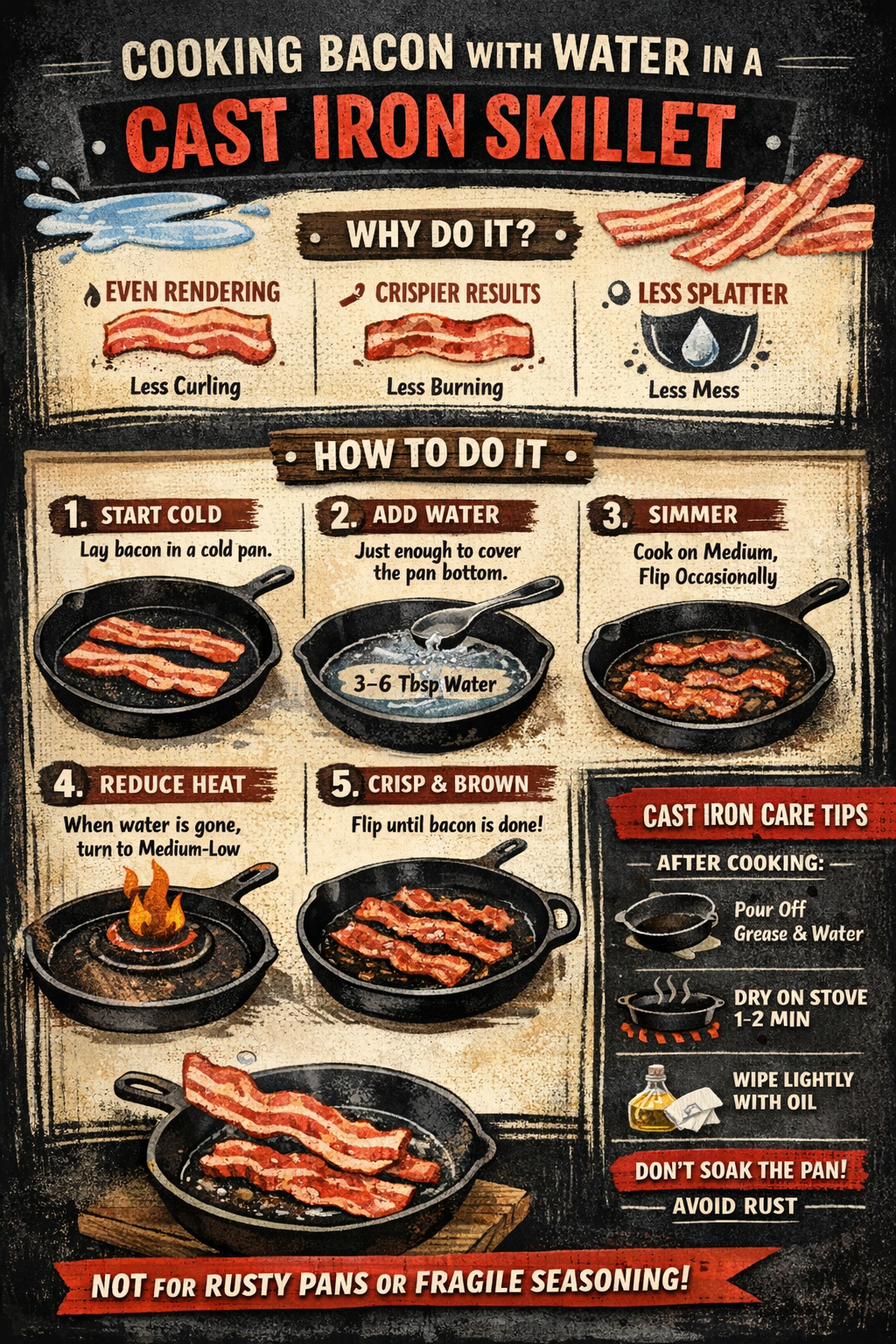
Best practice steps for cast iron (quick version)
- Bacon in cold cast iron.
- Add a thin layer of water (just covers bottom).
- Heat to medium until simmering.
- Flip occasionally during simmer.
- When water’s gone, drop to medium-low, flip often.
- After cooking: wipe out → quick rinse if needed → heat dry → wipe a film of oil.
When to avoid the water method in cast iron
- Your pan is bare/actively rusting, or seasoning is extremely fragile.
- You’re trying to do very high-heat bacon bits fast (water adds time and control, not speed).
If you tell me how your cast iron is (newly seasoned vs old workhorse), I can tell you exactly how careful you need to be on the cleanup/dry-oil step.
You said:
make a pintrest style infographic for my blog on this subject of this conversation
You said:
I was not intending to create an infographic that is focused on cast iron pans Create the infographic to be more universal types of pans that most people have at home